
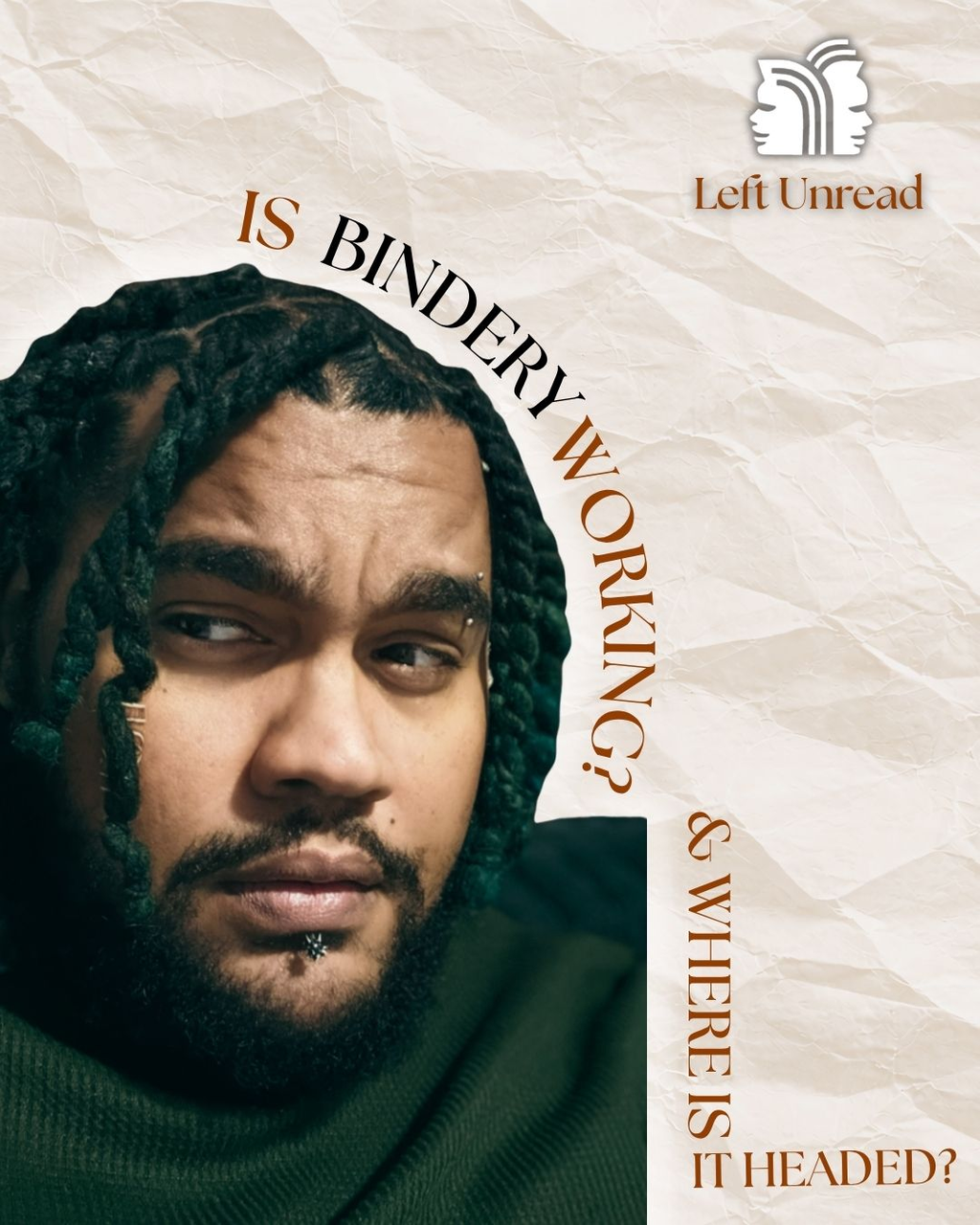
Is Bindery working and where is it headed?

I am horrible at the content creator gig. I know that if I want to optimize my platforms, I should be taking every meaningful piece of content I make and cross-posting or adapting it for each of my unique platforms. But in general, I just don't do that. The conversations I have on TikTok are very different than the ones I have here, or on Threads/Instagram. And I honestly can't put my finger on why I'm like this. But it's just who I am. I don't like to revisit a thought once I have fully explored it organically somewhere.
However, today I am going to resist my nature and bring you a conversation that I have already had elsewhere, because I see incredible value in what I have to say here and I want to make sure it gets heard (or read, in this instance).
A few days ago, someone sent me one of the latest episodes of the BookRiot Podcast because they had briefly mentioned Bindery during the episode and, well, this friend knows I'm nosy as hell. So, despite the fact that I typically don't have enough of an attention span to really listen to podcasts, I went and gave it a listen, and my friend was right. I found it fascinating.
To be clear, the episode was not about Bindery and during the segment that was, they were just having a conversation about their initial reaction to the way Bindery is being discussed online. This blog is not an attempt to engage directly with them, nor do I have any ill-intent toward them. I just want to explore the actual conversation that was brought up.
Without quoting them, basically their thoughts boiled down to two questions:
Is Bindery's model working and what will Bindery become?
I want to take a few minutes to weigh in on both of those questions as someone who has invested a lot of time, energy and resources into partnering with Bindery.
So... let's dive in.
Is Bindery's model working?
I think this is a very fair question. And it is one that I think can be very difficult to really measure without close observation because, unfortunately, the publishing industry is very weird. Lol. I know that isn't the most eloquent way to say it, but it's true. Not only is this industry unbelievably difficult to successfully break into, but it can be hard to measure success within it as well.
Take Amazon rankings for example. If you have spent more than five minutes in BOOKISH spaces you have probably come across at least ten books with a #1 Amazon Best Seller sticker. Which is exciting and amazing and deserves to be celebrated. But if you are not invested in this industry in some way, you probably don't have a real frame of reference for what that accomplishment means, sales wise.
Amazon has many different types of rankings. It has an overall ranking for all of its physical sales and an overall ranking for all of its ebook sales. However, it also breaks those sales down by category, and by subcategory. The vast majority of the time a book achieves a best seller sticker on Amazon, it is for a subcategory, not an overall ranking.
What does that mean? It means that the book in question is not competing against the millions of books listed on Amazon. It is competing against thousands, or even hundreds...or even less, depending on the category. And to even further contextualize this, it is only competing against books in that category that have sold copies during the time frame that is being measured. So sometimes, that banner speaks to thousands of sales. But sometimes, it could be a handful, depending on how competitive the category.
Getting that banner is always a major accomplishment. I am not downplaying that at all. I think any author that is celebrating reaching #1 in any category should be unbelievably proud and should openly brag about it. But as an outsider, sometimes seeing that best seller ribbon on Amazon can lead you to believe a book is selling far more impressively than it is.
The hosts of the BookRiot Podcast know this, so I am not surprised when they look at us being talked about in major magazines and news outlets and still manage to wonder if our being celebrated is proof that our model is actually working, or if we have cracked the code on running an excellent PR campaign.
I can only speak with authority for Left Unread, as I do not have intimate access to the inner workings of other imprints. But based on my experience partnering with, and working intimately with, this company, there are two things that I can say with certainty:
-- Our PR efforts are focused on clearly expressing our ambitions and pointing toward measurable proof that we are serving our authors to the best of our ability, not on convincing you we are already successful.
&
-- The vast majority of Left Unread's press coverage has come from people observing my actions within BOOKISH communities, not from Bindery's team building connections for me.
In the two years I have been working toward building this community, we have been featured on a New York Times Billboard, in Elle Magazine and on the cover of Indie Author Magazine, where I and my work were called "A Bridge to Inclusion" because of how successfully we are fighting for change on behalf of marginalized authors. And on top of all of that, we have also been featured in multiple blogs/podcasts/Substack posts and in dozens, if not hundreds, of pieces of content made organically by BOOKISH creators.
Our first (and only currently released) book, Cry, Voidbringer was featured by Elle Magazine as one of 2025's best Fantasies. Publisher Weekly called it "An unsparing look at cycles of violence" and "brutal but impressive". It was picked up by two book boxes, receiving special editions from both Rainbowcrate and Satisfiction. And less than five months after publication, it was shortlisted for a major literary award, the Lambda for LGBTQIA+ Speculative Fiction.
As far as outward, observable metrics, our model is absolutely working.
But more important than the accolades, I think we need to reexamine what success actually means in this industry. Because while we are succeeding by the standards most people hold Publisher's to, I think those standards are a little underwhelming. Which brings me to...
What will Bindery become?
This is honestly the question that I am most eager to tackle because, while listening to the BookRiot podcast, one of the hosts made a prediction that has sat with me. She said that we would not be able to replace mainstream publishers (which I agree. Those companies are not going anywhere) but that maybe we could be an alternative option for authors who couldn't succeed with mainstream publishers.
I don't think that she intended anything offensive by that, but I do think it is a sentiment that is worth exploring. Because the truth is, I am not convinced the majority of authors are being served well by Big 5 publishers at all. You see it every single day. Authors coming to the internet to offer transparent conversations about the ways their publishers failed to serve them. And, for the record, I do not believe that means editors are picking up projects they have no intention of fighting for. But the unfortunate truth is, publishing, the way it currently exists, is primarily a numbers game. Major publishers have a select number of editors who are investing very limited time, energy and money into far more projects than they can possibly serve well, knowing that a small percentage of those projects will end up succeeding well enough to cover the losses for the books at the very bottom. Leaving the majority of traditionally published authors either unprofitable, or modestly profitable, while a handful keep these massive corporations empowered to control the industry.
I have to be honest with you... I don't really see a model that leaves most people underserved as successful.
One of the reasons that Bindery exists is because our founders--Matt Kaye and Meghan Harvey--saw the number of systemic barriers keeping this industry from progress and decided to attempt building something that operated without those barriers. They saw an opportunity to do things differently and chose to radically disagree with what ethical publishing looks like.
And I really don't think anyone objects to that idea. As a whole, I think people are even excited about the idea of a publishing model that attempts to dismantle some of the barriers that exist in this industry. Where I think a lot of people get hung up is the idea of doing it through community.
Let's talk about the elephant in the room... the primary thing that sets Bindery apart is the fact that, instead of acquiring editors, Bindery is choosing titles by partnering with bookish creators like myself, who are empowered to invest Bindery's resources and expertise into projects that directly speak to us and the community of readers we represent.
I want to have a candid conversation about that model and what it means for the future of publishing.
From the outside looking in, a lot of people in this industry have come to view bookish influencers as a bit overcelebrated. As if we take ourselves a bit more serious than we should. When in reality, major publishers put a lot of effort into courting us for a reason. Bookish creators have the ability to connect publishers directly to readers in a way that their other marketing efforts cannot replicate. And while big five publishers see that as an opportunity to capitalize off of our platforms, Bindery saw an opportunity to approach publishing from an entirely different position.
By partnering with us, instead of just attempting to win access to our influence, Bindery envisioned a publishing model where we can produce books that have their own built-in audiences. Knowing that this industry is literally designed to keep marginalized voices out, community is the most important element to what we do here. By centering readers in our publishing process, we are able to ensure that every single author we sign is served to the absolute best of our ability.
That is the secret sauce. From the outside, it looks like Bindery's model is just capitalizing off of Internet celebrity. But that's not accurate. Our model centers built-in community. It was not my platform that rocketed Cry, Voidbringer into the world, it was the thousands of readers who committed to making sure this book succeeded. The value of our platforms is not that we can sell books, it is that we can mobilize people and build something that can challenge systemic barriers that have thrived for centuries... and win.
What am I saying?
For many of the people who exist in this industry, success has always meant producing a Sarah J maas or a Tracy Deonn. And truthfully, I am sure we will. Because that type of success is a numbers game and we are here for the long-haul, so it's only a matter of time. But that is not my biggest goal as a publisher. Yes, I want our books to all sell phenomenally well. But I don't think that is the most important thing we can fight for. And I don't think most people will if they are looking at the industry in its entirety. From my perspective, success here means a model that actually serves authors as a rule, rather than as an exception. Success, to me, means building a publishing model where none of our authors are left behind.
In my opinion, Bindery is not a consolation prize or an alternative for washed up authors. Quite the opposite, in fact. I think we are a disruption to an industry that isn't working. And I think we are an answer to bigotry that is foundational to publishing in the west. Not the only answer. But certainly one of them. Because for us, there is no A team and B team. Every single project is designed for success. Obviously, we cannot force a book to do any certain numbers. But by centering community, we are able to fight as hard as humanly possible for every single title. And as a result, we are seeing a consist level of success that is not being replicated by the majority of publishers.
Which matters if our objective is to create space for the authors in the margins. Especially Black and brown authors, who have historically been left to fend for themselves.
And I want to be clear: there is nothing wrong with self-publishing. I am a huge advocate for self-publishing and I believe we should be buying and celebrating those authors. But real access means Black and brown authors having the option to pursue publishing in whatever capacity they want to. Which has not been the case. Instead, Black authors fought for decades to build on their own because traditional spaces wouldn't include them. And I think that is something we can help fix by challenging what publishing can look like and forcing the entire industry to recognize that making space for Black and brown people was never a risk and the only thing keeping them from success was the racist standards being used in traditional publishing models.
So where is Bindery headed?
In my opinion, through the ceiling. I think that the work we are doing, if its integrity is protected, could easily challenge the standards that many of us hold for the publishing industry. We are proving that many of the stories they call risky are more than able to flourish when they are celebrated instead of feared.
I do want to emphasize one sentence above though. That sentence being: if its integrity is protected.
As I have already openly said hundreds of times, I believe this industry is unbelievably racist. In fact, I see white supremacy as the foundation of the modern publishing industry. And there is a reason that it has continued to thrive despite every challenge it has faced. In 2020, Readers got very serious about demanding change and major publishers finally felt pressured into promising it. And yet, six years later, despite all of their efforts, Black and brown authors are still an afterthought and change is nothing more than a far off idea that no one seems resourced enough to actually produce.
White supremacy is tenacious. It was well designed and is empowered by the fact that every western industry is working in partnership with it. So resisting is no small task.
If you have been a part of this community since the beginning you know that I have worked my ass off to make sure that Left Unread stays at the top of the game. I have worked tirelessly to ensure that not only are our projects successful, but that our voice continues to be loud. And I have partnered with other Black and brown tastemakers here time and time again to help make sure that the work Bindery is doing centers the voices of marginalized people. Especially Black and brown people.
Not because I think we have more value, but because in this industry, it is easier to leave us behind than to create space for us. And for any effort to successfully challenge white supremacy, Black and brown voices need to be loudly present. Which is where community continues to be critical.
I believe in the work we are doing here. And I believe that work will continue to be more and more successful. I truly believe Bindery is going to be a massive disruption in this industry.
I also believe that if we want that disruption to challenge the systemic barriers keeping Black and brown people out, we need to be very intentional about making sure we center the fight for Black and brown people in the way we build. Which is why I am going to end this already obnoxiously long blog with a few calls to action, because I am not just interested in competing with massive publishers. I want to crush white supremacy's hold on them and force the entire industry to shift the way it engages with marginalized people. Which means ensuring that our voice continues to be a part of the conversation as this company issues its challenge to the entire industry.
ACTION ITEMS
If you see the work we are doing at Bindery as important to the future of publishing, please consider investing into Left Unread every month. Upgrade your subscription to the $5 or $12 (or even the $25 if you've got it) tier and help us to significantly build this imprint so that we can truly be a force of change in this industry. Keeping Black and brown people at the center of movements like Bindery is building is CRUCIAL to challenging the systems of power keeping our art stifled.
Invest in our next two projects. Every single project we put out matters as we build this imprint and work toward making an impact. You can invest in Devil of the Deep and Buzzard by adding them to your Goodreads TBR and pre-ordering your copy right now. I will drop some links right here:
Consider supporting the other Black and brown imprints that are fighting for the same thing. I know it is not fair to ask you to invest money in a bunch of imprints every month, but at the very least, please go subscribe to all three of them for free and consider supporting them by buying/reading their books!
Boozhoo Books is run by Naomi Darling (@fromthemixedupdesk). We cannot decolonize without Black AND Indigenous people. Consider supporting her imprint by subscribing at whatever tier you can.
Boundless Press is run by Jananie. She is south Asian and focuses on a lot of the same conversations that I do. If you enjoy the way I talk about publishing and the fight for change, I think you will resonate with her work as well.
BOOKS: Burn the Sea
Mareas is run by Marines, an afrolatine woman who is focused on publishing Black and Latine stories that make you think.
BOOKS: Orange Wine & Our Sister's Keeper
I love the work I am doing here at Bindery and I am so proud of the community we have built together. I believe we have an opportunity here to do A LOT of good for the world. And I am so grateful to every single one of you committed to helping us succeed.
Thank you. And let me know in the comments if you have any more questions about what we are doing here. I would love to continue this conversation and to offer more insights on Bindery and Left Unread.
Comments
Get the Bindery app

